You didn't buy a marketing problem.
You bought a scanner that's half asleep and a payment that isn't.
The lease payment goes out whether the scanner runs or not. So does the service contract, the tech's salary, the rent on the room it sits in, and the interest. Those costs are fixed. Your revenue isn't.
Which means every empty slot on your schedule isn't a missed opportunity. It's a cost you already paid and didn't get anything for. You can't bank it. You can't carry it into next week. At close of business it's simply gone.
And here's the part that stings: the marginal cost of running one more scan in an hour you're already open, already staffed, and already paying for is close to nothing. That slot isn't ordinary revenue. It's almost pure margin.
Most independent centers we look at are running their CT and MRI somewhere between 45% and 65% utilization.
Nobody sits down and prices out the other 35–55%. On a CT open 50 hours a week and running 60 scans, that is 65 study-length slots a week, paid for and never sold.
That capacity is already paid for. The only question is whether anyone is booking into it.
You have already tried to fill those hours.
An agency, a radius, an age range, “interested in health,” then hope. Maybe boosted posts. Maybe a discount that filled a few slots with people who wanted the cheap scan and could never have afforded anything else. So you concluded that self-pay does not really work in your market.
It was not your market. It was who the ad was shown to.
collected in a single month
Diagnostic imaging center, Sugar Land, TX
Not appointments booked and not what the deals might be worth one day. Money that landed in one clinic’s account in one month, from patients who came in on a calcium score.
How, in full: we booked the patients, and a dedicated upgrade specialist placed in the building by one of our partners had the conversation that turned them into full body CTs. That placement is a separate engagement and is not included in our fee, which we say everywhere else on this page too. We are showing you this number with the asterisk attached rather than without it, because it is the clearest evidence we have of what that seat is worth when somebody actually owns it.
One week. One clinic. Eighty-three booked appointments.
Every card is a CT appointment the clinic values at $1,200, which is what a calcium score patient is worth to them if they take the full body CT. Eighty-three of those is the $99,600 in the header. That is the ceiling, and not all 83 will get there. Forget the ceiling. This is what a week like that actually puts through the scanner.
- 83
- booked in one weekEvery one of them put money down to hold the slot.
- 74
- walk inNine in ten show. That is what the deposit buys you.
- 22
- upgradeThirty percent of everyone who walks through the door.
- $26,400
- from that one week of bookingsAt $1,200 an upgrade, which is a full body CT off the calcium score. Those patients come through the schedule over the following weeks, not all at once. It is the floor, not the ceiling: a Houston clinic took the same entry offer to $11,266.
That was a strong week, and we are not going to pretend every week looks like it. The $34,000 above is what a full month at this same clinic actually collected.
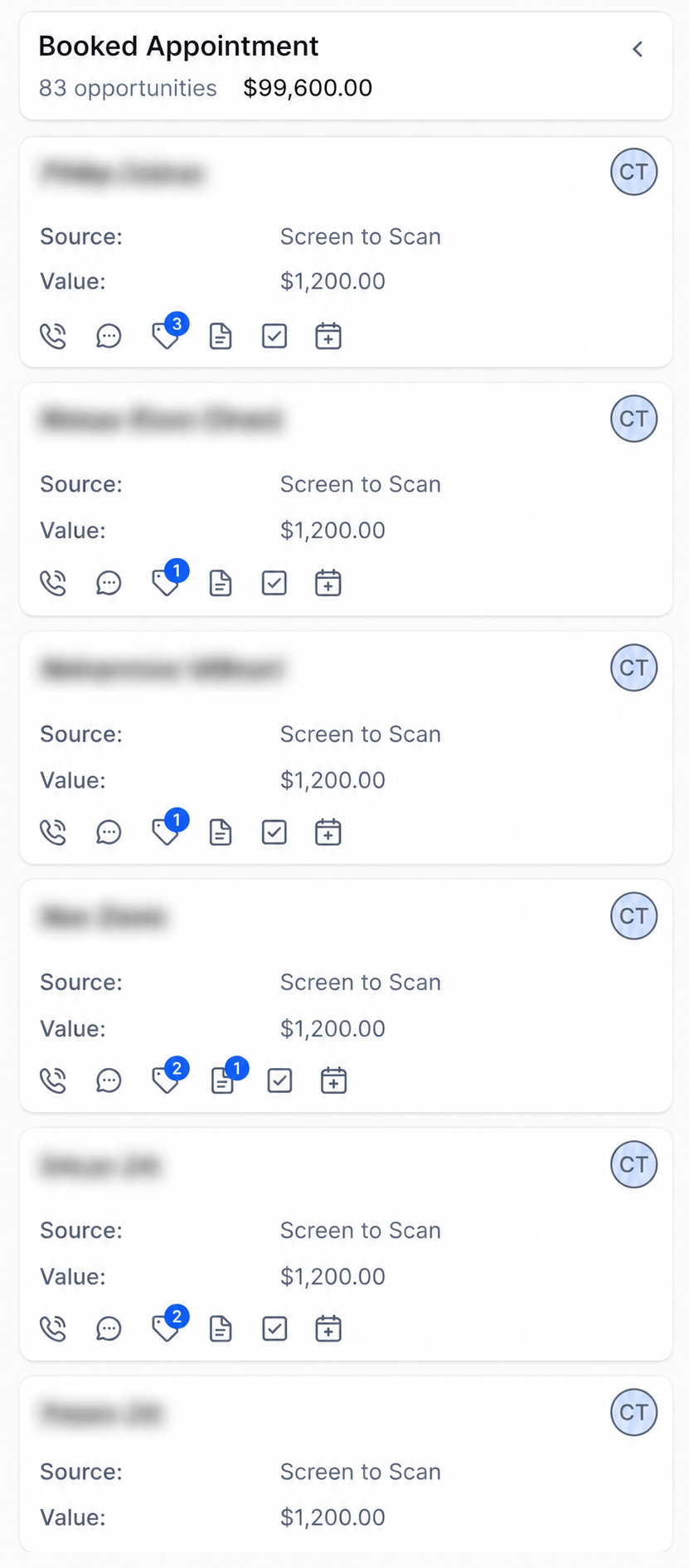
Patient names redacted. Every card is tagged CT and valued at $1,200, which is the full body CT upgrade. 83 of them is the $99,600 in the header, and that is the ceiling if all 83 converted. The working alongside is the realistic number.
Open full sizeNames are redacted, the board is not. This is the pipeline itself, not a case study written about it.

Both patients entered on the same couples heart scan offer.
Open full sizeMeta cannot target this. We can.
The difference is not better ad copy or a smarter bid. It is knowing which households to put the ad in front of before a dollar is spent, and Meta has no setting for the thing that actually matters.
All three, at the same time
- Household income that can absorb the full study
- Anyone will take a low-cost heart scan. The question is who says yes to the four-figure full body CT after it, without financing it or thinking about it for three weeks. We filter for the households that can.
- Active health and wellness intent
- Real, recent search and browsing behavior around wellness coaching, health monitoring devices and wearables, longevity clinics, and premium gyms. These are people already spending money and attention on their health.
- Close enough to actually drive to you
- Not a ZIP code guess. Households near enough to your building that getting there is a non-issue, worked out from your real drive times rather than a circle on a map.
Then we put your ad in front of exactly those households.
We hand Meta that exact list of households and tell it to show your ads to those people and nobody else, on Facebook and Instagram. Meta has no setting that would let you build this list yourself, which is why the agencies that only know Meta never do.
Licensing this data is a five-figure-a-year commitment on its own. We carry it, not you: no data fee, no audience fee, no line item on your invoice.
What that does to the cost of a lead.
Across our live accounts that is 2,871 heart scan leads at $5.57 apiece over the last 180 days, in four markets across three states. The receipts are below, and the full breakdown by service line is on the next screen.

1,022 leads across these three campaigns at $50/day. Clinic names redacted.
Open full size
196 leads at $1.75. Different market, same entry offer. Cost per lead moves with market and creative, which is why we show you the range and not one row.
Open full sizeThree service lines. We will not quote you someone else’s.
Most agencies show you their best cost per lead and let you assume it applies to your center. It does not. What a lead costs depends entirely on what you are selling, and we run three lines at three completely different numbers. All three are below, including the one that looks bad.
CT heart scan and calcium score
Last 180 days
2,871 leads at $5.57 each, on $15,992 of ad spend.
| Market | Offer | Leads | Per lead |
|---|---|---|---|
| Houston, TX | Couples heart scan | 603 | $6.40 |
| Plano, TX | Couples heart scan | 595 | $6.25 |
| Oklahoma City, OK | Couples heart scan | 430 | $8.59 |
| Sugar Land, TX | Heart scan | 621 | $2.16 |
| Sugar Land, TX | Heart scan | 206 | $3.73 |
| Sugar Land, TX | Heart scan | 220 | $6.80 |
| Sugar Land, TX | Couples heart scan | 196 | $5.70 |
The same offer, four markets, three states. The spread runs $2.16 to $8.59 and we are showing you all of it rather than the best row. That is the part that matters: it is not one clinic and it is not one lucky month.
MRI screening
Last 180 days
494 leads at $18.90 each, across two dedicated MRI centers.
| Center | Offer | Leads | Per lead |
|---|---|---|---|
| Brooklyn, NY | $299 MRI | 311 | $18.09 |
| Oak Park, MI | Open MRI scan | 183 | $20.26 |
Two MRI centers in two different states, landing within two dollars of each other.
An MRI lead costs roughly three times a heart scan lead. You should hear that from us now rather than find it out after you have signed. If anyone quotes you a five dollar lead for MRI, they are quoting you a cardiac screening number and hoping you do not check.
Insurance, auto accident
Minneapolis, MN
$6,991 of ad spend. $68.54 a lead.
About 7.2x back.
That cost per lead looks terrible. Here is why we are showing it to you anyway.
- Ad spend
- $6,991
- Leads
- 102 at $68.54
- Patients seen
- at least 5, about $10,000 each
- Patient value produced
- about $50,000
- Cost to acquire a patient
- about $1,398
Cost per lead is the wrong question. The only question is what the patient is worth when they arrive. This is the one line where we can follow the money the whole way, and it returns about 7.2 times the ad spend.
If your mix is mostly insurance, this is the number to look at, not the cheap one above it.
What an average day looks like.
Sugar Land, TX. The $79 couples heart scan, running right now. Not a best week and not a launch spike, just the average of the last 21 days.
$53
Ad spend
9.4
Leads
1.2
Appointments booked
2.2
Patients through the door
Two patients per appointment, because it is a couples offer. That works out to $44.86 per booked appointment and $24.38 per patient through the door.
On 17 September, one of those ordinary days, a couple who came in on the $79 couples heart scan bought a $1,999 full body scan.
That is the entire model in one line. The screening is bait and it is priced to be an easy yes. The study is the business. This happens on a day that otherwise looked exactly like the four numbers above it.
This is what the deposit is actually for.
The same clinic ran both of these at the same time, over the same three weeks. One takes a $25 deposit to hold the slot. The other is free.
$79 couples heart scan
$25 deposit
92%
of booked appointments confirmed
23 confirmed out of 25 booked
Complimentary heart scan
No deposit
16%
of booked appointments confirmed
17 confirmed out of 105 booked
The free offer booked four times as many appointments and produced fewer confirmed patients. A cheap offer with nothing at stake fills a calendar with people who will not turn up, and an empty slot someone promised to fill is worse than an empty slot nobody claimed, because you stopped selling it.
This is the single biggest reason low-cost screening campaigns fail, and it is the reason we collect on your behalf before a slot is held.
Seven steps. Your team is involved in only one of them.
- 01Week 1
We build your entry screening offer
On CT that is a calcium score marketed as a heart scan, the entry every self-pay result on this page came through. On any other modality we build the equivalent around what your rooms can actually deliver. Either way it is priced to be an easy yes for a self-pay patient and priced against your real cost per scan, so the front end never loses you money. This is bait, not the business.
- 02Week 1
We match your market against the database
High-income households near your clinic with active health and wellness intent. We hand Meta that exact list before a single ad runs.
- 03Week 1–2
We reactivate the list you already own
Before a dollar goes to Meta, we work your existing patient database. It costs no extra ad spend, and it starts working immediately, so you are not waiting on a brand new ad account to find its feet before anything happens.
- 04Week 2
The campaigns go live
Running only against the matched audience, on Facebook and Instagram. You pay Meta directly from your own ad account. We never touch your spend and we never mark it up.
- 05Ongoing
A Conversion Specialist works every single lead
Phone, SMS, email, until they book or they say no. This is a person assigned to your account, not a chatbot and not your already-buried front desk.
- 06Ongoing
A deposit is collected before the slot is held
Usually $50, collected on your behalf and straight into your account. It is your money and we never touch it. The single biggest reason cheap-offer campaigns fail is no-shows. A patient with money down shows up. A patient who clicked an ad does not.
- 07The revenue
Your upgrade specialist has the conversation
They came in for a screening. Where clinically warranted, that becomes the full study: a full body CT at around $1,200, a full body MRI, or in the right case a multi-modality package in five figures. This is not a front desk job, it needs someone who owns it, and we give that person the scripts, the answers to what patients push back on, and the training.
That was the CT version. Yours may differ.
The machine changes, the system does not. Same household database, same matched audience, same follow-up to a deposit-paid appointment. What changes is the entry offer, because it has to be something you can actually deliver at a price your market will say yes to without thinking about it.
- CT and MRI, full body capable
- The best fit we have, and the centers we build for first. Largest carrying cost, longest idle blocks, and the biggest gap between what a patient walks in for and what they leave having bought.
- CT or MRI, no full body study today
- Still works. The entry offer and the upgrade both get built against the studies you do run, and we will tell you on the call what that ceiling realistically looks like before you sign anything.
- ultrasound, DEXA, mammography, X-ray, PET
- The calcium score is the entry we have the most data behind, and every number on this page came through it. For any other modality we build the entry offer around your equipment on the call rather than handing you a template that was designed for somebody else’s scanner.
The deposits alone cover what you pay us.
On an entry-level calcium score campaign we book 12 to 15 appointments a week on average. Most clinics hold each of those slots with a $50 deposit.
The deposits by themselves have already covered what you pay us. That is before anyone pays for the calcium score itself. Before a single upgrade to a full body CT. Before the upgrade revenue that is the actual point of all this.
Clear that line and everything above it is upside.
12 to 15 a week is the average we see on an entry-level calcium score campaign. Volume varies by market, screening price, and offer. Deposit amounts are set by you, $50 is what we see most often. The math above uses only those two numbers and our fee.
What we need from you
Charge patients the price we advertised
Whatever the ad says, the front desk charges. Changing it at the door kills bookings and makes the ad false.
Keep slots open to scan them
We pace volume to whatever capacity you tell us you have.
Someone who owns the upgrade conversation
A patient care coordinator or dedicated upgrade specialist. Not your front desk. This is the one role that decides whether a screening patient stays a screening patient.
Do not have anyone in that upgrade seat yet? In most clinics this is not a new hire. It is usually a patient coordinator, a lead tech, or a practice manager who grows into it, and the training is included in your fee. If you genuinely have nobody, we can help you place someone. That is a separate engagement, not included in the marketing fee, and you get the number on the call. The clinic behind the $34,000 above had that seat filled.
Beyond that: no new software for your staff to learn, no insurance claim to chase, no marketing meetings. If we are adding work to your front desk, we have failed at the thing you are paying us for.
Done-for-you self-pay patient acquisition
One program, and everything in it is included. There is no upsell tier and no à la carte menu.
What's included
- A dedicated Conversion Specialist working every lead by phone, SMS, and email
- Deposit collected before the appointment slot is held
- Ad spend paid by you, directly to Meta. Zero markup, you see every dollar
- Campaigns live within 14 days, and volume paced to your real capacity, never past it
booked, deposit-paid appointments in your first 60 days, or we work free until you get there.
Not a refund you have to chase. We keep working at no charge until the 20th patient is on your schedule with money down.
We are setting that bar where we can see it. One clinic booked 83 in a week, so 20 in 60 days is not a number we expect to be tested on.
Conditions, stated up front rather than buried: leads worked during your business hours, advertised pricing honored, capacity available, and at least $50 a day in Meta ad spend maintained.
After the first 60 days it keeps going: any month we produce no booked appointments and no revenue, your next month is free.
One rate. One center per market.
No upsell, no add-ons.
Everything above is included at this price. There is not a better version of this for more money.
What you pay each month
- Our fee
- $2,000/mo
- Meta ad spend, minimum $50/day
- $1,500/mo
- Total
- $3,500/mo
The ad spend goes from your account straight to Meta. We never touch it, never mark it up, and you see every dollar in your own billing.
The deposits you collect typically cover our fee before a single patient buys anything.
90-day initial term, then 30 days notice.
This is wrong for a lot of centers.
We take one center per market and we'd rather leave a slot open than fill it badly. Read this honestly before you book.
Don't book a call if…
- You will not run an entry screening offer at all. That front door is the whole system
- Your revenue is 100% insurance and you want it to stay that way
- You’re already at capacity and turning patients away
- You want to run the ads yourself and just need a consultant
- You need results this week. Reactivation is fast, but it is not instant
- You’re looking for the cheapest agency you can find
Not having CT is not on that list. It used to be. Centers running MRI, ultrasound, DEXA, mammography, X-ray or PET are worth a conversation, and what we would run for you is above.
The questions you're actually going to ask
We do not have CT. Does this work for us?
Yes, and we will tell you straight what changes. The targeting, the matched audience and the follow-up to a deposit-paid appointment are identical no matter what is in your rooms. What changes is the entry offer. The calcium score is the front door we have run the most and every figure on this page came through it, so for CT centers we are handing you something already proven. For MRI, ultrasound, DEXA, mammography, X-ray or PET we design the entry screening around your equipment and your market on the call, rather than handing you a template built for a machine you do not own. Centers with both CT and MRI that can deliver a full body study are the best fit we have, because that is where the upgrade is largest. Everyone else is worth a conversation.
What is the database, exactly?
A proprietary household dataset we match against your market. It identifies people near your clinic who have both the income to pay for a full diagnostic study and recent, active interest in health and wellness: wellness coaching, health monitoring devices, longevity clinics, high-end gyms. We hand those specific households to Meta as the exact list to advertise to. Meta has no setting that goes this deep on its own, which is why most imaging ads get shown to everyone in a 25-mile radius and burn budget on people who were never going to upgrade.
Can I even run imaging ads with HIPAA in play?
Yes, and it is the part most generalist agencies get wrong. Health-category advertising has real constraints on targeting, creative, and how intake data is handled. We build inside those constraints from day one rather than bolting compliance on after an account gets restricted.
How long until something happens?
Campaigns are live within 14 days of signing. Alongside that we work your existing patient list, which needs no ad spend and starts working immediately, so you are not waiting on a brand new ad account to find its feet before anything happens.
What if it does not work?
If we have not put 20 booked, deposit-paid appointments on your schedule in your first 60 days, we keep working at no monthly fee until we have. Not a refund you have to chase and not a credit against something else, just us working for free until the number is hit. The 60 days start when your campaigns go live rather than when you sign, so waiting on access does not eat your clock. After that first window it keeps going: any month we produce no bookings and no revenue, your next month is free. We set the bar at 20 because we can see it from here. One clinic booked 83 in a single week.
What if we are almost entirely insurance-based?
It can still work. Most of what we do is self-pay, but the same targeting and the same Conversion Specialist run insurance-based service lines too. For one Minneapolis clinic we are booking auto-accident therapy patients worth roughly $10,000 each. Bring it up on the call and we will tell you honestly whether your mix is a fit.
Find out what your idle hours are worth, on a call, with your real numbers.
Thirty minutes. No deck. We work through your actual capacity and pricing and tell you straight whether there is a self-pay lane worth building here. If your market is already claimed, or your mix is wrong for this, you will hear that on the call instead of a pitch. You do not need the entry offer built or priced before we speak; working that out against your numbers is the first thing we do.
Before you book
If a partner, spouse, or practice manager shares in this decision, add them to the call now. We cover a lot of ground in a short window and you'll want the right people in the room to move on it if it's a fit.
One center per market · Questions? 954-737-4430